Cameroon Part 3 – Trekking

Adventures

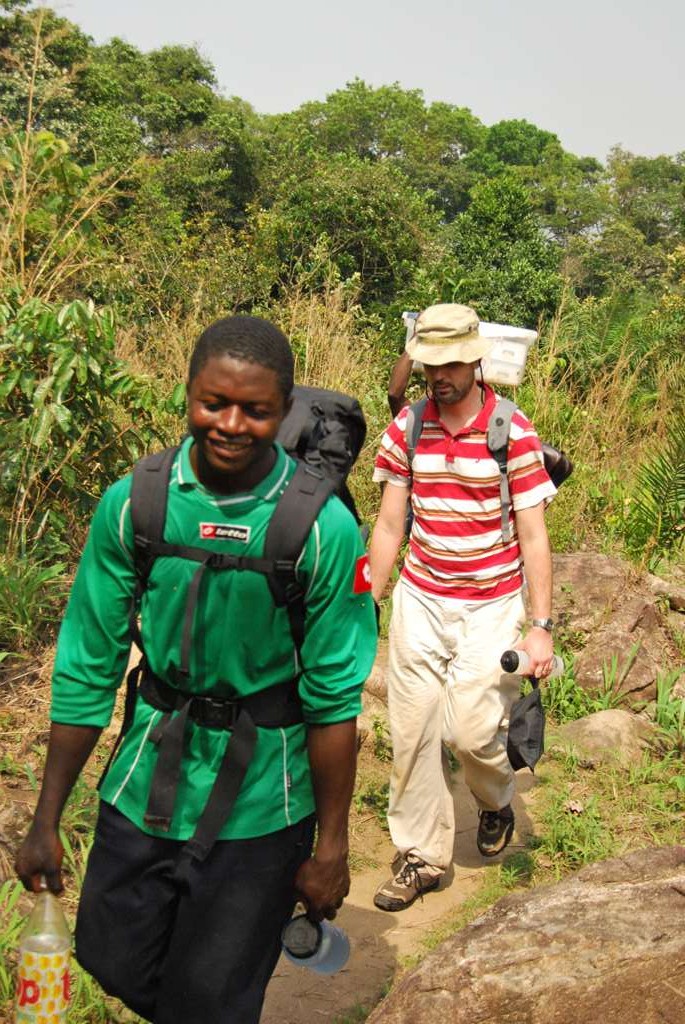
One of the enjoyable parts of the trip was a three-hour trek trek2between two villages — Amanavil and Olulu. This was probably a 10-mile trek and from that you know that there were a lot of ascents and descents. Also, we Americans were not as fleet-footed as the Cameroonians who make treks like this pretty regularly.  I think I was in fair shape because after a sustained climb, my breathing and heart rates returned to normal pretty quickly.

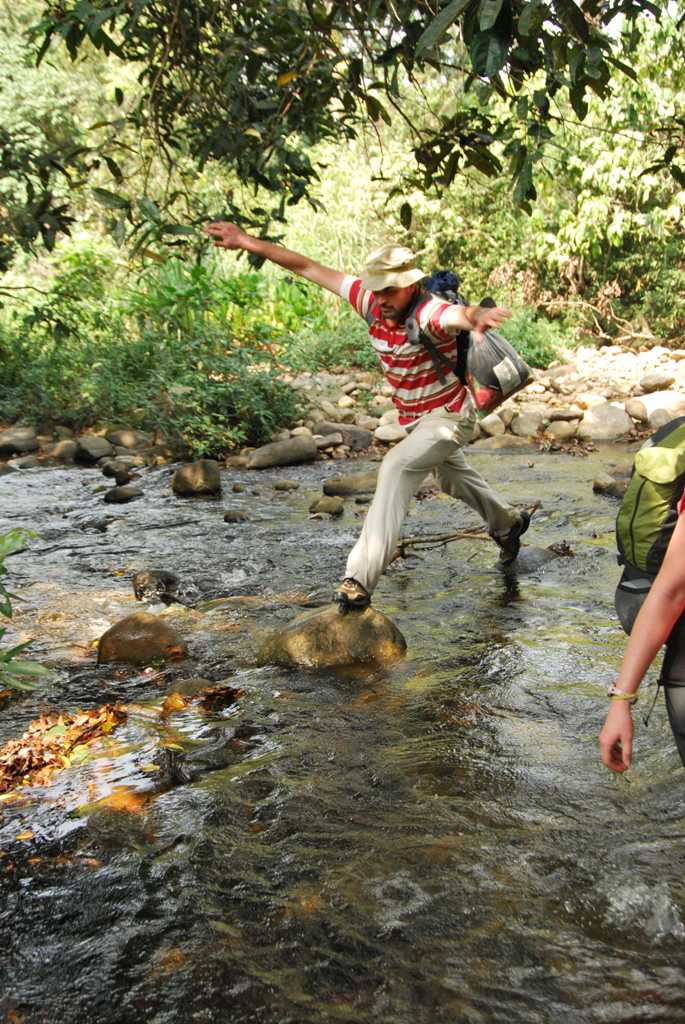
There were a few small rivers to cross and because it was the dry season, you could cross them mostly on stones.  trek1There was one, however, where everyone took off his socks and shoes and waded.  Tom Mike reckoned he could make the final long double jump and so I told him, I was up for the challenge.  He got his legs under him, made the second to last and then the last stone, and then climbed up on the bank.  I got my legs under me, made the second to last stone, and though I had the distance, missed the last stone to the left.

There were plenty of beautiful panaoramas along the way, but I guess the locals are used to seeing those because they did not stop to take them in.  All things considered, the trek was exhausting, enjoyable, and satisfying.

Next time…bush meat.

grep is great

Axioms

Here’s an old axiom.  I post it now so it gets back onto this site in the correct category and also since you may have forgotten it and we never want to forget axioms.

Pound-for-pound, grep is one of the best programs ever written. What if you could use grep in real life? You could find your remote control, find out which of your dresser drawers has socks, find a car within your price range. Awesome!

Cameroon Part 2 – Fabricating Parts Cameroonian Style

Adventures

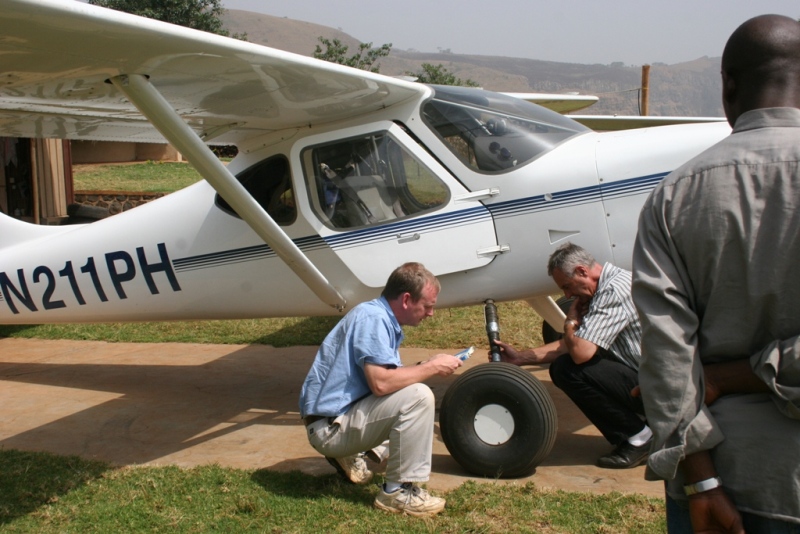
Not long after N211PH moved into the starting lineup, she bent that right landing gear leg again.  So now we had to decide whether to fall back on N37JN or fix the gear leg.  We chose to at least try a repair on the gear leg.  Terry and Tom reckoned they could straighten the leg but it would be weakened from bending so it would need reinforcement.  A leaf spring from a car would do.

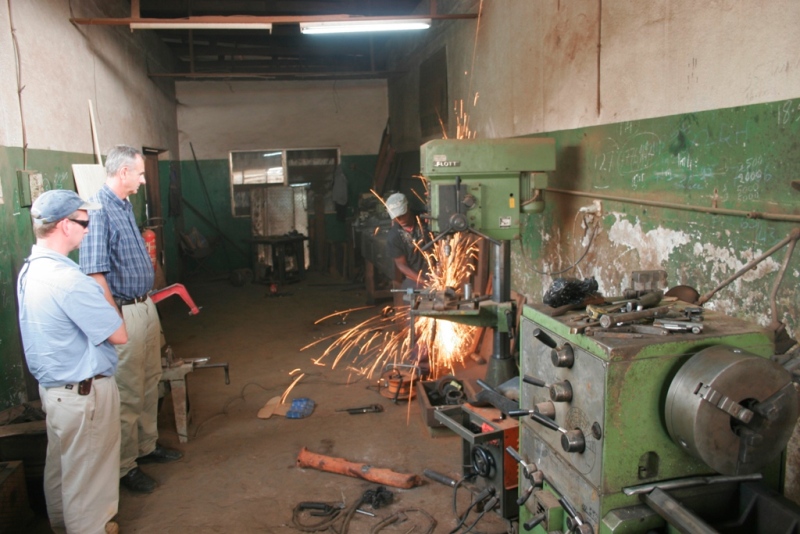
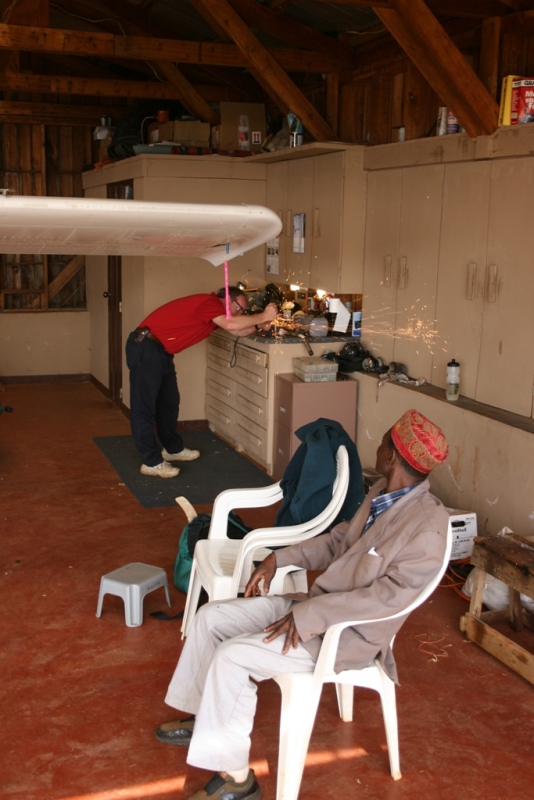
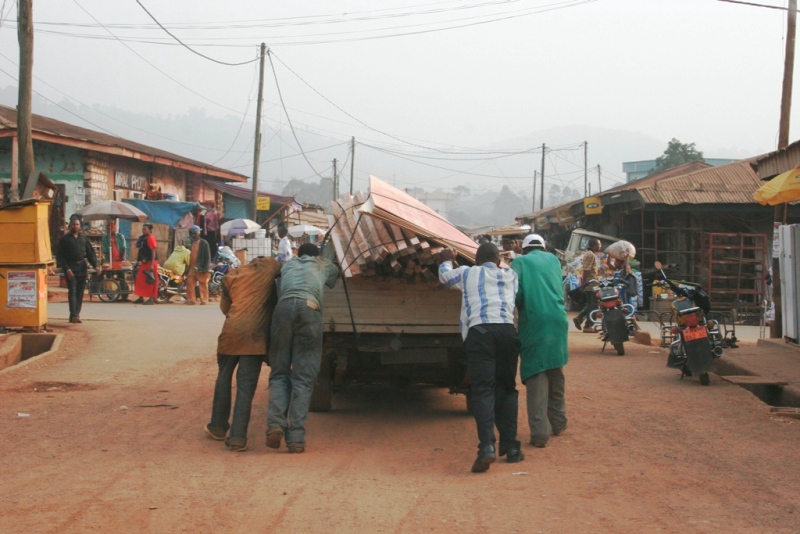
The three of us headed to town in search of a leaf spring and some rubber strips.  Finding a leaf spring was not difficult; there is a thriving used car parts industry in Bamenda.  Finding the rubber strips was easy; there is a tolerable market for used inner tube, tire, and other rubber strips in Bamenda.  From the rubber strip shop, we headed over to a machine shop where Tom knew of a hydraulic press.  While the technician was setting up the press, I pointed out the welding machine that had an intriguing steel grounding block instead of a clamp and promptly about it.
n211ph-fabrication0

Notice the rod and ground.

Presently, the straightening started and I stepped back and kicked what turned out to be a live welding rod into said grounding block.  It went like this: spark, zap, silence, …hilarity. They finished by cutting the spring to the shape of the gear leg and we noted that the man cut the spring freehand but still cut it straight.  He did not wear safety glasses.

After using the rubber straps to bind the leaf spring to the gear leg, we tried a taxi test and a few landings.  Everything looked good but after each landing the leg showed an increased deviation from vertical.
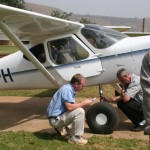
angle-checking

Checking the gear angle

So it would need more reinforcement.  Maybe a leaf spring from a truck would do.

We headed to town yet again and by the same means collected a truck’s leaf spring and four muffler clamps.  This time we headed to a different fabrication shop:  We noted the requisite live welding machine and gave it a wide berth.  They straightened the gear leg and then cut our leaf spring to the right length and width.  This time we noted that the man made the customary mark and then cut freehand, but he put sunglasses on about half-way through the job.
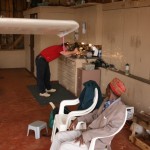
Clamp fitting
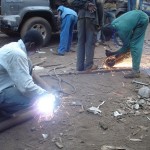
Clamp fitting

n211ph-fabrication2

Look Ma, no mask.

He cuts the truck's leaf spring.

Cutting the leaf spring.

This fellow, instead of clamping the spring, however, had his companion stand on it.

We took the parts home and Terry customized the muffler clamps to fit the wide end of the leaf spring.  We clamped the spring to the leg and ran the same sequence of test.  This time, the leg gave a little and then held.  Success!

In part 3, we shall learn some small thing about trekking.
Cameroon Part 1 – Airplane Batteries in Africa

Adventures

I figure there are probably some folks hankering for a recounting and a few pictures of the trip to Cameroon.  I figure there’s no way I could tell the whole story in one post.  Probably, I could tell it in three to six posts, but that would take some serious time too.  Instead, I think I’ll let the story out in the form of anecdotes as they come to me.  Herewith is part 1 of at least 2.

N211PH Repair No. 1

N211PH Repair No. 1

When we first got to Cameroon, Terry and Tom swapped out the spring steel right landing gear leg of Tom’s Glasair Sportsman (N211PH).  Then we attempted to get her running.  Amongst other problems, the battery was dead, so we went to town to seek a battery that would fit an airplane.  Keep in mind, that this is a country, larger than California, that boasts around 15 airplanes.  Naturally we went to the motorcycle battery store to look for the proper size and voltage cell for an airplane.

Searching Bamenda

Searching Bamenda

Well, would you believe that in a city of 500,000 it took us half of the day to find the only battery in town with the right length and width, but it was to high?  And would you believe that the fellow who aided us in our search offered to cut the top off the battery and shorten it for us?  As you will read in part 2, I found that these Cameroonians are skilled at salvaging parts, so I believe he would have done it and done it well too.  Since it was for an airplane, however, we declined.

In the end, N37JN had to ride the pines so N211PH could use her battery.  The latter was a larger ship and could transfer people and supplies much quicker.

Lesson 17 – Valentines Day

Adventures

For Valentine’s Day, I asked the bride of my youth to fly with me for an hour.  She needs to gain some confidence in my abilities so it was an opportunity to gradually introduce her to flying in a Cessna 172 with a romantic overtone.  We started off practicing some takeoffs and landings and I soon realized that with passengers who are new to small airplanes, the pilot may need to shallow out most of his turns.  The winds were fairly gusty, they were quartering from the right, and my crosswind landings still need work, so we decided to do a little sightseeing instead.  We flew over to Omro and back to Oshkosh and then landed and let C get out while we practiced a few more crosswind landings.  My technique is getting better, but I still need to get better at correction.  I am looking forward to practicing some more.

Afterward, we stopped for dinner at Fratello’s on the Fox River and had the privilege of seeing a bald eagle.  We figured it was unusual to see a bald eagle in the city but probably the birds that normally hang out to the west of Oshskosh had come to the open water to find fish.

Lesson 16 – Solo

Adventures

During lesson 16, I took my first solo flight.  It was a gorgeous day for flying, with temperatures at 20 degrees, calm winds, and sunny skies.  You really can’t ask for better.  My good friend CP was excited to hear that I might solo and wanted to bask in the excitement and ambiance of the airport in January, so he came along to hang out.  When we got onto the airport, it was apparent that several others wanted to play in the sun too.  Among others, we shared the perfect weather with a gyrocopter, a Cessna 182, a Citabria, and flight of two consisting of an Ercoupe and a Cessna 120.  Those aren’t all aircraft you see every day.

We started with three dual takeoffs and landings. 

Lesson 15 – Takeoffs and Landings Some More

Adventures

Lesson 15 consisted of more takeoffs and landings practice.  Today was a pretty nice winter day and the winds were from 330 at about 5 knots, so there wasn’t much side slipping required on the landings.  Again, we ran a few takeoffs and landings on runway 27 and then a few more on runway 36.  There was a simulated engine failure and a forced go-around for practice, which I think I handled competently.  That was about the extent of the lesson.

I think I am finally starting to feel the flare and time it correctly.  I ballooned once, but it was minor and I did the right thing to correct it.  Also, I believe my precision was back up to previous levels and may be improving again.  I still have some work to do on crosswind landings, but today, all of my landings were pretty soft, so I’m ecstatic.

Lesson 14 – Crosswind Takeoffs and Landings

Adventures

Finally, we were able to take to the skies again.  The weather has been crummy all December so I guess we just had to wait till January of Aught-Nine and I’ll tell you one thing, it was a gorgeous day — bright sunshine and crisp air, but breezy.  There was a 30 foot long snow drift in front of the hangar so we started by shoveling a path for the airplane.  Upon starting the engine, I noticed immediately that I had failed to latch the left cowling hatch.  Apparently, waiting till the last minute to unplug the engine heater threw me off my game.  One must remember that when his routine is disrupted, he can forget simple things.  Most likely I shan’t forget that item again though.

The winds were from 290 at 9-10 knots so we took off on 27 and there wasn’t much of a crosswind.  We began the lesson by heading out to the practice area and trying out some sideslips and then some forward slips. Well, that was an adventure.  In coordinated flight, you always feel pushed straight down into your seat, but in a side slip and especially in a forward slip, your really are thankful for you seat belt and sometimes you use the OCHO (O Crud Hang On) handle.  After getting the hang of slips — which are relatively easy at 2200′ AGL — we headed back to KOSH for some touch-and-go practice.

We started on runway 27 and I could tell I was a little rusty from not having flown in three weeks.  The flares just weren’t coming back naturally.   In fact, I ballooned twice.  Also, on one takeoff, I got confused about holding aeleron against the wind and drifted to the right of the runway.  I think T may have explained something to me a little different than he had originally, but my mental lapse was just one of those things that happens to you when you’ve got more information trying to get into your brain than it is trained to process.  Well, we practiced a few more on 27 but since the winds were at 10 knots, it was prime time for some crosswind takeoff and landing practice, so we switched over to runway 36.

Crosswind takeoffs are a challenge.  You have to use your side slipping technique so that you can keep the airplane moving in a straight line (holding position on the ground but slipping into the wind) and still pointed straight down the runway.  You do this by lowing the windward wing and using opposite rudder to keep the airplane from turning.  Mostly there is a lot of hand and foot movement to get the position correct but you have to constantly adjust for wind and your position on the runway.  This is just a skill that will require a lot of practice.

The rust on my skills was also apparent in a generally lower level of precision.  For example, I did not hold altitude as well this lesson as last.  In the last lesson I generally stayed withing 20′ of pattern altitude, but this time I was sometimes more than 100′ above or below the pattern altitude.  Correcting these is just headwork, but sometimes that’s the hardest thing.  As the saying goes, practice makes perfect.